


About the Free Contraction Timer
Bump Pulse's free contraction timer times and tracks your contractions two ways: right here in your browser, with no sign-up, or in the Bump Pulse contraction timer app for iPhone and Android. Tap Start when a contraction begins and Stop when it ends. You see how long each one lasted, how far apart they are, and when the pattern reaches 5-1-1. It works as a contraction counter and calculator too: every contraction is numbered and kept in a running list, and the timer works out the averages for you.
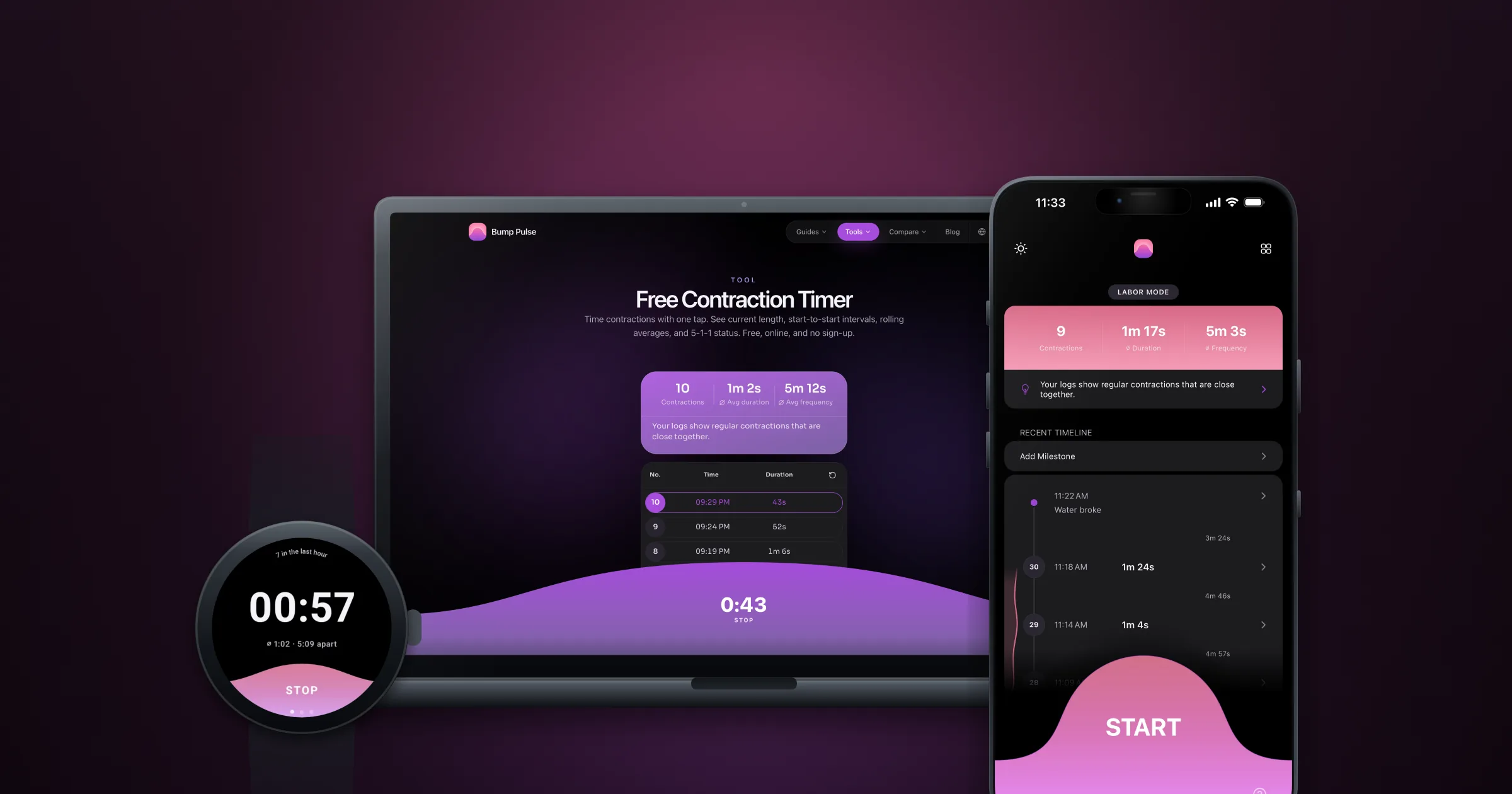
This tool is simple on purpose: no account, no ads, no complicated setup. Just open the timer, start tracking, and watch your contraction pattern build. Your contractions stay saved in this browser, so a refresh or a closed tab does not lose them.
What the Online Contraction Timer Tracks
- Current contraction length — shows how long the active contraction has been running.
- Contraction duration — records how long each completed contraction lasted.
- Interval between contractions — shows the time from the start of one contraction to the start of the next.
- Contraction count — a running total of how many contractions you have logged.
- Average duration — helps you understand how long recent contractions usually last.
- Average interval — helps you see how close together recent contractions are.
Using It as a Contraction Counter or Tracker
Alongside timing, the tool keeps a numbered count of every contraction you log. If you mainly want to count contractions in an hour rather than time each one, the contraction counter gives you that at a glance — the running total, plus how the intervals between contractions are changing. As a contraction tracker it also keeps the full list in order, so you can see the whole pattern rather than one contraction at a time.
How to Use the Contraction Timer
- Tap Start when a contraction begins.
- Tap Stop when the contraction eases or ends.
- Repeat this for several contractions in a row.
- Watch the duration, interval, and averages to understand the pattern.
- Contact your healthcare provider when your contraction pattern matches their guidance or you feel unsure. For best results, try to start the timer as close as possible to the beginning of each contraction and stop it when the contraction fades.
How Long Should You Time Contractions?
Time several contractions in a row, usually for about an hour, so a pattern can show. One or two contractions say little on their own. The last "1" in the 5-1-1 guideline is exactly that: about an hour of contractions in the same pattern. Follow the instructions your own provider gave you.
Contraction Duration vs Frequency
- Duration is how long one contraction lasts, from its start to its end.
- Frequency is how far apart contractions are, from the start of one to the start of the next. It includes the rest in between.
For example, a contraction starts at 10:00 and ends at 10:01, and the next one starts at 10:05. Its duration is 1 minute and the frequency is 5 minutes. The timer calculates both for you, so you never have to do the maths during a contraction.
Contraction Timing Rules at a Glance
| Rule | About this far apart | Each lasting about | For about |
|---|---|---|---|
| 5-1-1 | 5 minutes | 1 minute | 1 hour |
| 4-1-1 | 4 minutes | 1 minute | 1 hour |
| 3-1-1 | 3 minutes | 1 minute | 1 hour |
Providers use different rules, and some give a closer pattern to people who have given birth before, because labor can move faster. Sources describe a "3-2-1" rule in different ways, so ask your provider what they mean by it. "5-5-1" is not a common rule: it is usually a mix-up of 5-1-1. Whichever rule you were given, your provider's instructions come first.
What Is the 5-1-1 Rule?
The 5-1-1 rule is a common guideline used during labor. It usually means:
- Contractions are about 5 minutes apart.
- Each contraction lasts about 1 minute.
- The pattern continues for about 1 hour. Many providers use this as a general sign that it may be time to call, go to the hospital, or head to your birth location. However, every pregnancy is different, so always follow the specific instructions given by your doctor, midwife, or care team.
When to Call Your Midwife or Go to the Hospital
Your provider tells you when to call, and their instructions come first. Many use a pattern like 5-1-1, and some give a closer one, like 4-1-1 or 3-1-1, to people who have given birth before, because labor can move faster. Timing contractions helps you describe that pattern clearly when you call.
Some things are a reason to call straight away, whatever your contractions are doing:
- Your waters break, or you think they might have.
- You have vaginal bleeding.
- Your baby is moving less than usual.
- You have constant, severe pain, or pain that does not ease between contractions.
- You have regular contractions before 37 weeks.
- Anything feels wrong, or you are unsure.
Labor Timing Figures
These are typical figures from guidelines, not a forecast for your labor. Every labor is different.
| Topic | Typical figure | Source |
|---|---|---|
| Early (latent) labor | Has no standard length, and varies widely from one person to the next | WHO |
| Active labor, first baby | Usually lasts no longer than about 12 hours | WHO |
| Active labor, later babies | Usually lasts no longer than about 10 hours | WHO |
| Regular contractions before 37 weeks | Can be a sign of preterm labor, so call your care team | ACOG |
Braxton Hicks or Labor Contractions?
Practice contractions, called Braxton Hicks, are often irregular, do not get closer together, and may ease when you rest or change position. Labor contractions usually come in a regular pattern and get longer, stronger and closer over time. A timer shows you which pattern you have, but it cannot tell you which kind they are. The Braxton Hicks checker walks through the signs, and your provider can tell you more.
What a Contraction Timer Can't Tell You
A timer measures time only. It cannot measure how strong a contraction is, how far labor has progressed, or whether you or your baby need care. Use it to describe your pattern to your provider, not to decide on your own.
Online Contraction Timer vs Bump Pulse App
| Feature | Free Online Timer | Bump Pulse App |
|---|---|---|
| Contraction timing and counting | Yes | Yes |
| Current contraction length | Yes | Yes |
| Duration and interval tracking | Yes | Yes |
| Average duration and interval | Yes | Yes |
| Saved contraction history | Saved in this browser only | Yes |
| Partner sharing | No | Yes |
| Apple Watch & Wear OS apps | No | Yes |
| Lock Screen / Live Activity controls | No | Yes |
| Push notifications for partner updates | No | Yes |
| No account required to start | Yes | Yes |
| The online timer is best when you want a quick, simple way to time contractions from your browser. The Bump Pulse app is better if you want history you can keep and edit, partner sharing, Apple Watch and Wear OS apps, and easier tracking during real labor. |
Example Contraction Pattern
For example, you may see:
- Contractions lasting around 1 minute.
- Intervals around 4–5 minutes apart.
- A similar pattern continuing for several contractions. If this pattern continues and matches the guidance you were given, contact your healthcare provider or follow your birth plan.
Safety Notes
This contraction timer is a tracking tool only. It does not diagnose labor or replace medical advice. Seek immediate medical care or contact your provider if your water breaks, you have bleeding, severe pain, reduced fetal movement, or anything feels wrong. Always follow your healthcare provider's advice and local triage guidance.
Sources
- How to tell when labor begins, American College of Obstetricians and Gynecologists
- Signs that labour has begun, NHS
- WHO recommendations: intrapartum care for a positive childbirth experience, World Health Organization
- Preterm labor and birth, American College of Obstetricians and Gynecologists